
Introduction
Choosing the best hotel bed sheet fabric is not simply about selecting the softest material or the highest thread count. Hotel buyers need to balance guest comfort with durability, commercial laundering performance, dimensional stability, maintenance requirements, and procurement cost. In practice, 100% long-staple cotton is often preferred for luxury properties, while poly-cotton blends can provide a practical balance for high-frequency hotel operations. The right choice also depends on yarn count, weave, and the intended property positioning.

Which Fabric Is Best for Hotel Bed Sheets
The two most practical fabric directions for hotel bed sheets are 100% long-staple cotton and cotton-polyester blends. Each serves a different balance of comfort, appearance, durability, and operating efficiency.
100% Long-Staple Cotton
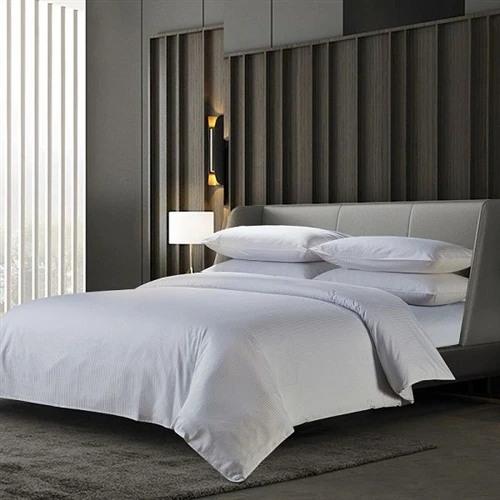
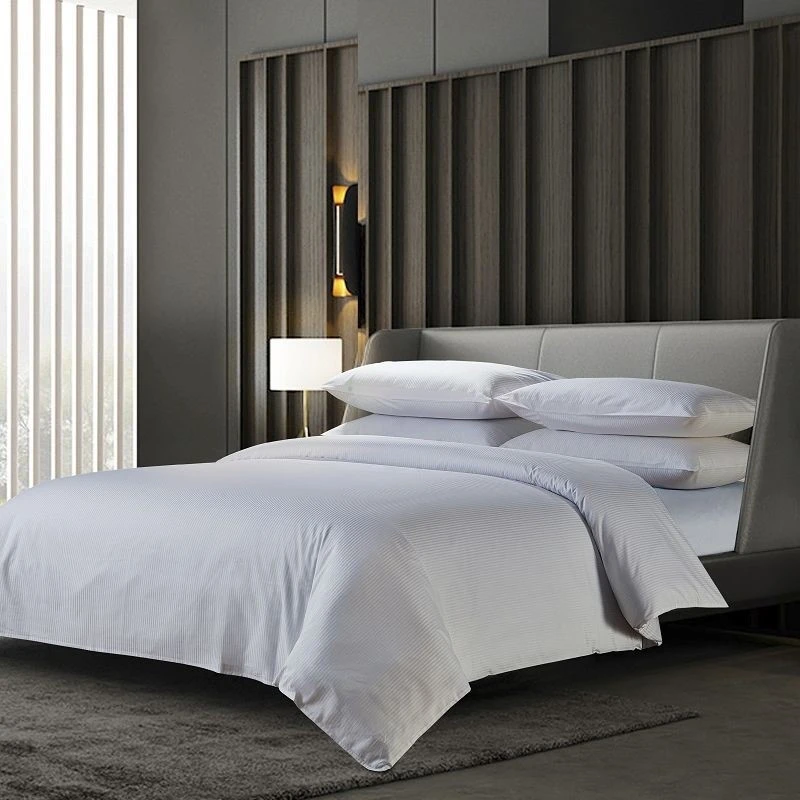
100% long-staple cotton is a premium choice for five-star hotels, luxury resorts, presidential suites, and properties where guest comfort is a major part of the brand experience. Its longer cotton fibers can contribute to a smoother hand feel, good moisture absorption, breathability, and a naturally comfortable surface for direct skin contact. Satin stripe, sateen, and Jacquard constructions can further enhance the refined appearance expected in upscale guestrooms.
Poly-Cotton Blend
A poly-cotton blend is often more suitable for economy, business, and high-occupancy hotels. Polyester can reduce material cost while improving dimensional stability, helping sheets maintain their size and shape through repeated commercial laundering. The blend can also provide easier care, reduced wrinkling, and practical durability when bed linen is washed, dried, and ironed frequently.
How Do Thread Count, Yarn Count, and Weave Affect Hotel Sheet Fabric
Thread count should not be evaluated on its own. A more useful approach is to consider Thread Count + Yarn Count (S) + Weave, because these three factors influence fabric density, yarn fineness, surface feel, appearance, and overall performance.
|
Thread Count |
Yarn Count |
Weave |
Typical Characteristics |
|
180–200 TC |
20S–30S |
Plain Weave |
Breathable, Durable & Practical |
|
300–400 TC |
40S–60S |
Plain / Twill |
Softer Feel with Balanced Durability |
|
500–600 TC |
80S–100S |
Satin Stripe |
Smooth Surface with Refined Sheen |
|
800+ TC |
100S–120S |
Premium Satin / Jacquard |
Luxurious Hand Feel & Appearance |
A higher thread count does not automatically mean a better hotel bed sheet fabric. Buyers should consider fiber quality and yarn construction alongside TC. Plain weave is generally practical and breathable, while twill can create a more substantial feel. Satin stripe and premium sateen offer a smoother surface and subtle sheen, while Jacquard can introduce decorative texture for luxury applications.


What Makes a Hotel Bed Sheet Fabric Hospitality-Grade
A hospitality-grade fabric must perform beyond the first impression. Hotel sheets may experience repeated high-temperature washing, industrial drying, high-speed ironing, folding, and daily bed-making. The fabric therefore needs a construction and finishing process designed for repeated commercial use.
Commercial laundering performance helps determine whether a sheet can maintain its functional and visual properties through intensive washing and drying cycles. Color fastness and anti-pilling performance are also important for maintaining a clean, consistent bed appearance after repeated use. Finally, controlled pre-shrinking helps improve dimensional stability, allowing sheets to retain a consistent fit and making routine bed-making more efficient.
Why Does OEKO-TEX® Matter for Hotel Bed Sheet Fabric
Because hotel bed sheets remain in direct contact with guests for extended periods, material safety is an important part of fabric selection. OEKO-TEX® Standard 100 can provide an additional reference for evaluating textiles for harmful substances. For international hotel groups, distributors, and professional hospitality buyers, certifications related to textile safety can support more consistent sourcing requirements. Buyers should also consider whether the selected fabric meets the safety and compliance requirements of their target market.
How Should Buyers Match Fabric Specifications to Their Property
The ideal specification depends on the property's positioning, guest expectations, laundering frequency, and operating budget. For a more detailed comparison of recommended sheet specifications for different property types, just see our article How to Select Hotel Bed Sheets for Different Property Types.
What Can Buyers Customize When Sourcing Hotel Bed Sheet Fabric
Commercial buyers may need to customize more than fabric composition. Depending on the supplier, options can include custom sizes, yarn count, fabric weight, thread count, weave, colors, satin stripe or Jacquard constructions, private labels, and export packaging. Sidefu supports customized hotel linen solutions that can be matched to specific product and branding requirements. Buyers can also coordinate the same fabric direction across duvet covers, pillowcases, and mattress protectors to create a more consistent guest-room bedding system.


Conclusion
There is no single best fabric for every hotel. 100% long-staple cotton is well suited to properties prioritizing premium comfort and refined presentation, while poly-cotton blends offer practical advantages in cost control, durability, and dimensional stability. By evaluating composition together with thread count, yarn count, weave, and hospitality-grade performance, buyers can select a hotel bed sheet fabric that better fits both guest expectations and daily operating demands. If you are still not sure that which fabric is suitable for your application, please contact our experts for a tailored recommendation.